At a glance
Container to silo trailer transloading is the logistics backbone of European plastic granulate imports. Polyethylene and polypropylene from Asian and American producers arrives in 20’ or 40’ sea containers loaded with FIBC big-bags. End customers — extruders, injection molders, film producers — need that material in silo trailers, ready for pneumatic transfer directly into plant silos.
The Chorula terminal handles this interface for major importers serving the Polish, German and Central European markets.
| Parameter | Value |
|---|---|
| Throughput | 200 t/day |
| Container types | 20’, 40’, 40’ HC, 45' |
| Container-to-trailer time | 2.5–4 h |
| Free storage | 7 days included |
| Hygroscopic handling | Yes, humidity-controlled hall |
| Standard | ISO 9001:2015 |
| Location | Chorula, Poland, 4 km from A4 |
Why Chorula for European container imports
Three factors drive the choice of Chorula as transloading hub:
1. Geographic position
The Chorula terminal sits at A4 motorway, 4 km from junction Gogolin. A4 connects Western Europe (Berlin, Frankfurt, Paris via A4/A2 corridor) to Eastern Europe (Kraków, Lviv, Kyiv). 180 km from the Polish-German border.
For an importer landing PE granulate at Gdańsk port (Baltic Sea), distribution from Chorula reaches:
- Berlin: 6 h driving
- Vienna: 7 h driving
- Munich: 8 h driving
- Prague: 4 h driving
- All major Polish factories: 1–5 h driving
Compared to transloading at Hamburg or Antwerp port — Chorula is closer to Central European end customers, with lower last-mile cost.
2. Gravity infrastructure
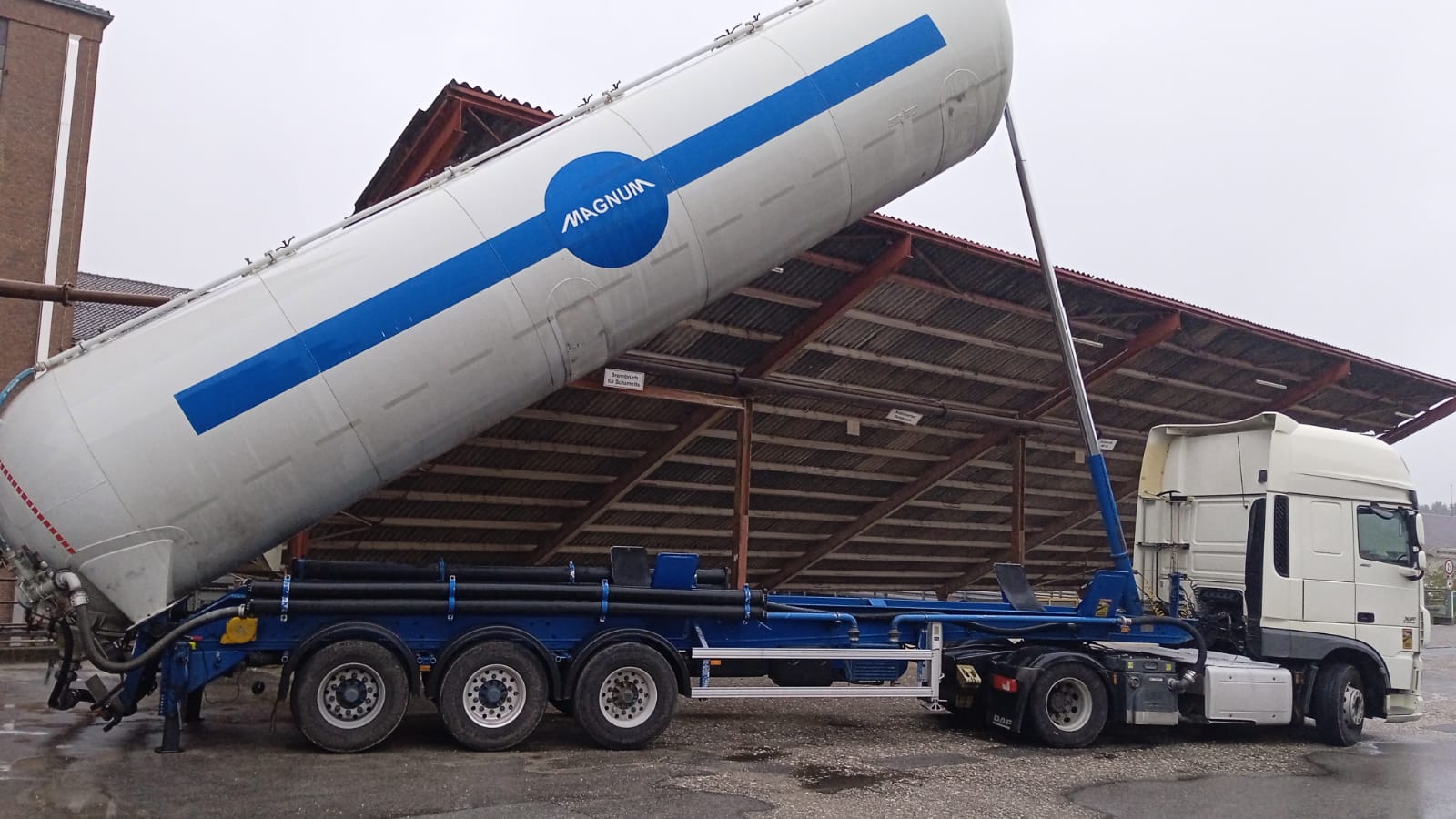
Chorula was designed specifically for FIBC-to-silo gravity transloading. The 200 t/day capacity is real, sustained — not a paper specification. Multiple major importers use Chorula because alternatives (port terminals, generic warehouses) lack the dedicated infrastructure:
- 3 dedicated transloading bays with silo trailer access from multiple sides
- Forklifts with food-grade certification (no diesel exhaust contamination)
- Overhead crane for large or non-standard FIBC formats
- Humidity-controlled storage zone for sensitive grades
3. ISO 9001:2015 corporate compliance
Major chemical producers (LG Chem, Borealis, Synthos, SABIC) have strict quality requirements for any third-party handling. The Chorula terminal operates under ISO 9001:2015 certification with documented procedures audited annually. Customers can request audit results, SOP documentation, and incident records.
This compliance level eliminates one of the biggest objections from end customers: “Who handled my material between port and my silo?” The answer is documented, traceable, and verifiable.
Workflow — container arrival to silo trailer departure
Pre-arrival coordination
Standard process starts 48h before container arrival at Chorula:
- Shipper sends advance notification: container number, B/L details, material spec
- SMIALA confirms time slot
- Receiving silo trailer scheduled (customer coordinates with their carrier)
- Customs status confirmed (cleared at port, or to be cleared at Chorula)
Container arrival
Truck with container arrives at Chorula gate. Documentation review takes ~10 min:
- B/L, CMR, customs documents
- Seal integrity check (T1 transit container or post-customs)
- Inbound weighing (gross weight)
Truck proceeds to unloading bay. If container is post-customs, immediate unloading. If T1 transit, parked in bonded area until customs clearance (typically same day or next morning).
Big-bag extraction
Container doors opened. Forklift operator extracts big-bags one by one:
- Standard 20’ container: 20–22 big-bags (1000 kg each)
- 40’ HC container: 24–28 big-bags depending on configuration
- Each big-bag inspected visually for damage during extraction
Damaged big-bags (torn, wet, contaminated) are set aside for customer instruction. Standard practice: photograph, notify customer, wait for instruction before transload.
Silo trailer positioning and washing verification
Silo trailer arrives at loading bay. Pre-load procedure:
- Operator verifies compartment cleanliness certificate (driver provides)
- If clean certificate missing or insufficient — wash at our wash bay (45–60 min)
- Inlet flange verified (4" Storz or PERROT M108 standard)
- Compartment hatch opened
Gravity transloading
Big-bag lifted over compartment inlet. Operator:
- Secures bag in lifting frame
- Positions over inlet
- Opens spout (if equipped) or cuts bottom (manual)
- Lets granulate flow by gravity into compartment
Time per big-bag: 3–4 min. Operator monitors flow visually for irregularities — clumps, foreign matter, color variations.
Documentation and dispatch
Post-loading:
- Silo trailer to outbound scale (net weight)
- Transloading protocol completed: order number, weights, batch identification, photos
- CMR issued for outbound transport
- Customer receives electronic documentation (PDF + photos) within 1 hour of completion
Total time: container arrival to silo trailer departure: 2.5–4 hours for typical 20’ container with 20 t PE.
Material handling specifics
Polyethylene grades
PE-LD (low density) — most common imported grade. Standard handling, highest throughput. Typical bulk density 0.55 g/cm³. 1000 kg big-bag ≈ 1.8 m³.
PE-HD (high density) — denser, lower volume per kg. Bulk density 0.62 g/cm³. 1000 kg ≈ 1.6 m³.
LLDPE (linear low density) — similar handling to PE-LD. Some grades are more dust-prone — extra attention to opening procedure.
Polypropylene grades
PP-H (homopolymer) — standard handling, similar bulk density to PE-LD.
PP-Co (copolymer) — similar to PP-H but may include impact modifiers requiring careful storage temperature.
PP-Random (statistical copolymer) — for film and transparent applications, often higher quality spec requiring lower fines tolerance.
Engineering polymers
PA6, PA66 (polyamide) — hygroscopic. Container must be opened in humidity-controlled environment, transload within 24h. Octabin packaging often required.
PET (polyethylene terephthalate) — hygroscopic. Similar handling to PA, with extra attention to bottle-grade vs fiber-grade segregation.
PBT, PC, ABS — case-by-case handling. Contact us for spec confirmation.
Recycled grades (rPET, rPE, rPP)
Quality variability is the key challenge. We work with multiple recycler suppliers — typical workflow includes:
- Pre-arrival material sample review
- Optional screening (1–10 mm) during transload
- Detailed protocol documentation for downstream QC
Customer profile — who uses Chorula
The terminal serves three customer categories:
Major importers (>500 t/month)
Companies importing PE/PP for European distribution. Typical profile: 2–4 containers per week, established Asian supply contracts, downstream customer base of multiple end users. For these customers Chorula is part of standard logistics flow, with framework agreement and monthly invoicing.
Distributors with intermediate volume (50–500 t/month)
Plastics distributors holding stock for regional customers. Mix of containers and big-bag deliveries. Chorula serves as both transloading point and short-term storage hub.
End customers with periodic direct imports (<50 t/month)
Mid-size plastic processors who occasionally import directly for specialty grades not available locally. Chorula handles the FIBC-to-silo step plus optional short-term storage.
Logistics planning — getting it right
Container scheduling
For shippers importing regularly, optimal pattern:
- Notify Chorula 48h before container ETA at port
- Confirm material spec and silo trailer registration
- Block transloading slot
- Pre-arrange silo trailer pickup time
For one-off shipments:
- Send inquiry as early as possible (even months before)
- Confirm slot 1 week before container ETA
- Notify silo trailer carrier of pickup time
- Standard 4-hour slot
Buffer planning
Container arrival times are notoriously unpredictable. We recommend:
- Build 24–48h buffer between container clearance and silo trailer arrival
- Use the free 7-day storage to absorb supply chain volatility
- For just-in-time supply — coordinate with us for priority slot allocation
Multi-container coordination
For shippers importing 2+ containers per week, optimal scheduling:
- Stagger containers across days (avoid 2 same-day arrivals)
- Pre-allocate silo trailer pickups at Chorula
- Use weekly framework slot for predictable capacity
Pricing model
We do not publish standard rates — pricing depends on:
- Volume commitment (per-container vs framework agreement)
- Material complexity (PE/PP standard vs hygroscopic vs specialty)
- Storage duration (within 7 days free, beyond 7 days storage rate)
- Documentation requirements (standard ISO vs corporate compliance audits)
Standard inquiry response time: 2 business hours. Quotes are typically valid for 30 days.
For framework agreements (regular volume), pricing includes:
- Priority slot allocation
- Monthly invoicing (NET 30/60)
- Account manager dedicated to your operations
- Reporting customized to your QC requirements
Contact
PHS Magnum / SMIALA terminal
- Address: ul. Kościelna 9, 47-316 Chorula, Poland
- Dedicated phone: +48 664 135 005
- E-mail: biuro@magnumchorula.pl
- Operating hours: Monday–Friday 06:00–20:00, Saturday 07:00–15:00
Inquiry workflow:
- E-mail with shipment details (origin, ETA, volume, material spec)
- Response with quote and proposed slot within 2 business hours
- Confirmation, schedule entry, account setup
- Execution per agreed protocol
Related: Big-bag to silo trailer — detailed workflow · Big-bag storage · Asian import workflow · Visit our facility · Contact