At a glance
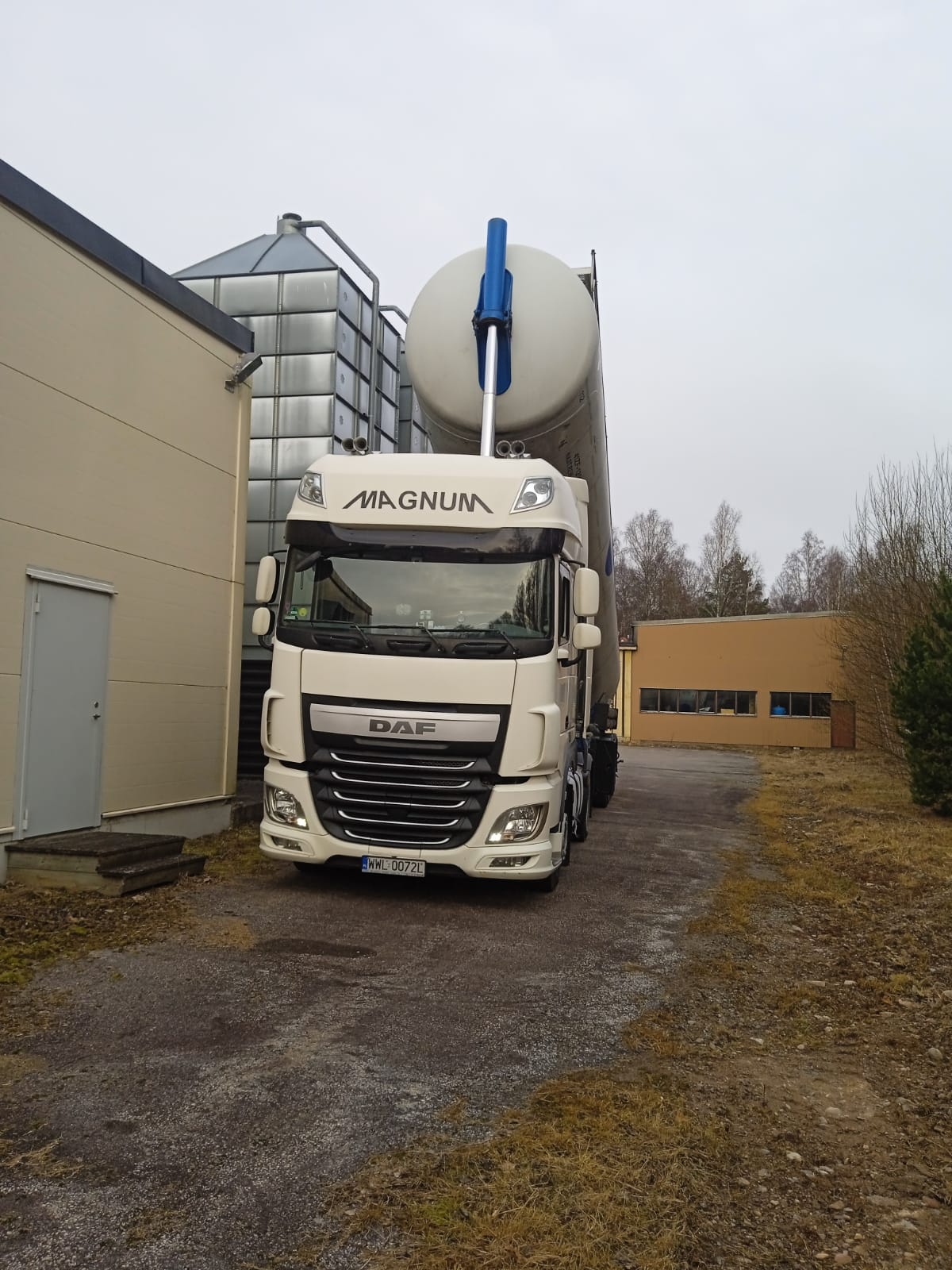
Big-bag to silo trailer transloading is a logistics operation transferring bulk material (typically PE/PP granulate) from FIBC bags directly into a cylindrical silo trailer compartment, performed by gravity — without any pneumatic transfer system.
| Parameter | Value |
|---|---|
| Throughput | 200 t/day |
| Big-bag warehouse | 2000 units |
| Silo trailer capacity | typically 60 m³ |
| 20’ container transload time | 2.5–4 h |
| Standard | ISO 9001:2015 |
| Location | Chorula, Poland, 4 km from A4 motorway, 180 km from German border |
The critical point: no pneumatics = no granulate fractionation, no contamination risk from air system. This is a requirement of corporate customers like LG Chem, Borealis, Synthos and HTNS.
Why gravity transloading matters for PE/PP granulate
Polyethylene (PE) and polypropylene (PP) granulates are strategic feedstock for the entire plastics industry. Extruders, injection molding, film extrusion lines — everything starts with pellets of strictly controlled geometry (typically 3–5 mm) and granulometric distribution.
Any transloading operation where granulate passes through a pneumatic system creates risks:
- Fractionation — fine particles (≤1 mm) separate from main mass. This disrupts dosing at the end user, causes process inconsistency, and may require additional sorting.
- Dust generation (angel hair, snake skin) — friction between pellets and pipe walls in elbows generates thin polymer fibers. These clog customer filters.
- Material loss — typically 0.5–2% in pneumatic transfer (dust in filters, fines in cyclones). At 24 t per batch that’s 120–480 kg.
- Contamination risk — pneumatic system after a different material (e.g. cement or mineral dust) requires deep cleaning that cannot always be verified analytically.
Gravity transloading eliminates all these risks. The big-bag is lifted above the silo trailer inlet and emptied by gravity into the compartment. Material never passes through any fan or filter — there is physically no such path.
Transloading workflow — step by step
1. Notification and time slot booking
Standard 24–48h advance notification. The customer provides:
- Container number or delivery plan
- Material specification (polymer type, bulk density, MFI/grade)
- Receiving silo trailer registration
- Required documents (CMR, cleanliness certificate, quality report)
A 4-hour slot is blocked in the schedule. Urgent deliveries (under 24h) — evaluated individually depending on terminal load.
2. Container/delivery reception
Driver with container arrives at the terminal gate (Chorula, Kościelna 9). Entry procedure:
- Identification, transport document check
- Inbound weighing (gross) on truck scale
- Drive to unloading bay
Time from gate to bay: ~10 min.
3. Big-bag unloading from container
Big-bags (1000 kg standard) are removed by forklift with 5 t capacity. Workflow:
- Big-bag pulled from container
- Moved to reception zone or directly to silo trailer
- Label scanning (if customer requires traceability)
A typical 20’ container holds 20–24 big-bags depending on size. Unloading: 45–90 min.
4. Loading into silo trailer
Silo trailer pulls up to the transloading station. Procedure:
- Positioning under inlet (4" Storz or PERROT M108)
- Compartment hatch opened
- Big-bag lifted above inlet (forklift with hook attachment or overhead crane)
- Gravity emptying — ~3–4 min per big-bag
Operator monitors granulate flow visually — in case of irregularities (clumps, foreign matter) procedure requires stopping and reporting to customer before continuing.
5. Final weighing and documentation
After loading — silo trailer to outbound scale (net weight). Gross-net difference = loaded material weight. Value enters the transloading protocol along with:
- Order number
- Start/stop date and time
- List of big-bag identifiers (when labeled)
- Silo trailer model and registration
- Operator and driver signatures
Documentation in electronic form (PDF, ZIP with photos) and paper if required.
6. Compartment washing and cleanliness certificate
Standard procedure includes silo trailer internal compartment washing prior to loading. For PE/PP granulate — dry compressed air washing + visual compartment inspection. For materials requiring higher standard (FDA-grade, medical-grade) — wet washing with detergent and drying.
Cleanliness certificate is a standard document — typically required by producers when switching products.
Technical terminal parameters
Infrastructure
- Warehouse area: hall sized to hold 2000 big-bags simultaneously
- Hall height: 6 m clear, allowing 2-tier big-bag storage
- Transloading stations: 3 dedicated bays with silo trailer access from all sides
- Scales: 60 t truck scale with national metrology certificate, 2 t warehouse scale
- Forklifts: 3 units, 3.5–5 t capacity, food-grade certified (Linde, Toyota)
- Overhead crane: 5 t, full station coverage
- Humidity control: dehumidifier-equipped hall for hygroscopic materials
Materials handled
| Category | Examples | Note |
|---|---|---|
| Polyethylene | PE-LD, PE-HD, LLDPE | Standard, highest throughput |
| Polypropylene | PP-H, PP-Co, PP-Random | Standard |
| Hygroscopic | PA6, PA66, PET, PBT | Humidity coordination required |
| Specialty | PVC, PS, ABS, recycled grades | Case-by-case contact |
| Minerals | lime, mineral cement, chalk | Only with coordination — separate bay |
Quality procedures
- ISO 9001:2015 — documented and audited procedures
- Silo trailer compartment washing — standard before each loading
- Visual inspection — operator observes flow during transload
- Control screening — optional 1–10 mm sieving for contamination suspicion
- Certified scales — national metrology calibration, full documentation
Customers and case studies
The Chorula terminal serves corporate customers across Europe. Regular transloading for:
- LG Chem — PE/PP granulate from Gdańsk port → silo trailers to factories in PL/DE
- HTNS — logistics operator commissioning transport, regular volume
- Borealis — coordination of transloads from Vienna
- Synthos — Polish-produced granulate to end customers
- Other recipients across Poland and the whole EU
Transloading in Chorula shortens the logistics chain:
- Without Chorula: Gdańsk port → rail/road container → customer warehouse (with big-bags) → manual extruder loading
- With Chorula: port → container → SMIALA transload → silo trailer → directly to customer silo
Savings: eliminate manual big-bag opening at customer site, eliminate warehouse processing, reduce packaging handling costs.
Packaging formats handled
Big-bag (FIBC)
Most common format. Bags 500–1500 kg, typically 1000 kg ≈ 1 m³ PE. Materials: woven polypropylene, four-loop, with or without bottom spout. Four-loop bags simplify operation — lifted with forklift cross-bar attachment.
Octabin
Octagonal cardboard container ~700 kg, typical for:
- Polyamides (PA6, PA66) — moisture-sensitive, octabin provides protection
- Some high-quality recycled grades
- Engineering polymers (PC, POM, PEEK) in smaller quantities
Octabin transload procedure differs — requires manual carton opening above the inlet. Time: ~5–7 min per octabin.
25 kg sacks
Format for smaller batches or specialty compositions. Foil or paper sacks, typically 55 sacks × 25 kg = 1375 kg/pallet. Manual transload — operator opens sacks above the hopper or directly above silo trailer inlet.
Sea containers
20’ and 40’ containers with big-bags, octabins or sacks. Container drives onto ramp, unloaded with forklift, further processing by internal packaging format.
Documentation and compliance
ISO 9001:2015 standard
All operations documented per ISO procedures. Internal audits annually, external certification by accredited auditor. Customers may request:
- Standard operating procedures (SOP)
- ISO audit results
- Incident reports (if any)
Corporate customer requirements
Customers like LG Chem have internal quality procedures — typically including:
- Mandatory silo trailer compartment washing with documentation
- No material contact with pneumatic system
- Cleanliness certificate per transload
- Batch traceability down to big-bag level
All these requirements are built into our standard process — no additional setup needed.
Food hygiene
For food-grade and FDA-grade materials — food-grade certified forklifts (white tires, food-grade oils), operator sanitary procedures, wet compartment washing with food-grade detergent and drying.
Logistics and location
Address: PHS Magnum, ul. Kościelna 9, 47-316 Chorula, Poland
Access:
- From A4 motorway (Gogolin exit): 4 km
- From Opole: 25 km, 30 min
- From Polish-German border (Zgorzelec): 180 km, 2 h
- From Gdańsk port: 480 km
Operating hours: Monday–Friday 06:00–20:00, Saturday 07:00–15:00. For urgent deliveries — coordination outside hours possible.
Dedicated phone: +48 664 135 005 — answered 06:00 to 22:00.
E-mail: biuro@magnumchorula.pl
Booking and contact
Standard ordering workflow:
- Inquiry — phone or e-mail, provide: material type, volume, packaging format, frequency, target date
- Individual quote — response within 2 business hours
- Delivery notification — 24–48h before delivery
- Execution — transload slot at agreed time
- Documentation — protocol and certificates sent electronically post-completion
For regular contracts — framework agreement with dedicated account manager, priority scheduling, monthly invoicing.
Related: Transloading — main page · Big-bag storage · Conditioning · Asian import · Contact