Definition
A 25 kg bag for granulate is a retail unit packaging of a standard mass of 25 kg, most often of polyethylene (PE) film or woven polypropylene (PP) fabric, used for packing, palletising and distributing granulates and other bulk materials to smaller customers. It is the last link in the plastics packaging chain: where the big-bag and the silo trailer handle the mass stream counted in tonnes, the 25 kg bag measures out a portion that a single worker can easily lift and carry.
This is the most underrated and at the same time the most frequently mis-selected packaging. It seems trivial — “an ordinary bag” — yet in reality its construction, material and method of closure determine whether the granulate reaches the customer dry, clean and free-flowing, or whether it cakes, dampens or spills out on the ramp. The 25 kg standard is no accident: it is a mass that can be packed on a pallet by 40 (1000 kg = one tonne = one big-bag), convenient for manual handling and consistent with the ergonomic limits of lifting.
In the plastics logistics chain the 25 kg bag plays the role of retail packaging: it holds less than an octabin or a big-bag, but in return it goes directly to a workshop, processing plant or injection-moulding line that uses a few hundred kilograms of material a day and does not need a whole tonne at once.
Types of 25 kg bags
Under the single name “25 kg bag” hide several entirely different constructions. The choice of type depends on the material, the barrier requirements and the method of packing:
- Valve bag — factory-welded on all four sides, filled through a side or corner valve. After filling, the valve closes automatically under the pressure of the material, so there is no need to additionally weld the top edge. It is a classic of semi-automatic and manual packing — fast, simple, without a separate closing operation.
- Open-mouth bag (welded or stitched) — filled from the top through an open inlet and then closed by a thermal weld (PE film) or a thread seam (PP fabric). It gives full control over filling and an even distribution of the material, but requires a separate closing station.
- FFS bag (Form-Fill-Seal) — made on the fly on an automatic line from tubular film. The machine forms the bag, fills it and welds the bottom and top in a single cycle. This is the most efficient and tightest technology, about which I write in more detail below.
- Multi-layer paper bag — of several layers of bag paper (usually 2-3), often with an internal HDPE film insert as a moisture barrier. Rigid, stacks well, used among others for mineral and chemical materials.
- Woven polypropylene bag (raschel or laminated) — of braided PP tape, very strong mechanically and tear-resistant. The raschel (mesh) version lets air through, the laminated one is sealed; for moisture-sensitive materials a laminate or an internal PE liner is used.
Materials and construction
The most important construction choice is the material of the bag wall, because it determines the moisture barrier, strength and weldability.
Polyethylene (PE) film is the number-one material for polymer granulates. Polyethylene is used in a single-layer or co-extruded (coex) version with a thickness usually of 100-180 microns. PE is thermally weldable, sealed, gives a clean and secure weld and protects well against moisture. For hygroscopic materials, multi-layer films or films with an additional HDPE layer are used, which significantly improves the moisture barrier while retaining the bag’s flexibility.
An HDPE insert as a moisture barrier is a solution typical of paper and woven PP bags, which are not themselves sealed. High-density polyethylene (HDPE) forms a thin but effective barrier against water vapour, separating the material from the paper or fabric. This makes it possible to combine the mechanical strength of the outer layer with the hermeticity of the interior — important for granulates in which even slight moisture causes injection defects (streaks, bubbles).
Polypropylene fabric is the material of bags in which what counts above all is resistance to tearing and puncture. The fabric is braided from polypropylene tape with a basis weight usually of 60-100 g/m². A raschel bag has a mesh structure and breathes, while a laminated bag is coated with an additional PP film, which gives it tightness and allows clean flexographic printing. The same polypropylene from which the bag fabric is made is, incidentally, one of the more common granulates we pack into these bags — closing a loop that nicely illustrates the versatility of PP.
Standard basis weights and dimensions
Although the name refers to 25 kg, in practice several standard unit-packaging masses are in use:
| Parameter | Typical value |
|---|---|
| Standard masses | 15 / 20 / 25 kg (25 kg — standard for granulates) |
| PE bag: width | approx. 40-50 cm |
| PE bag: film thickness | 100-180 microns |
| Woven PP bag: fabric basis weight | 60-100 g/m² |
| Paper bag: number of layers | 2-3 (+ HDPE insert) |
| Bags per pallet | usually 40 = 1000 kg |
| Layers per pallet | usually 8 layers of 5 bags |
| Pallet | euro 1200×800 mm |
The dimensions are not arbitrary — they are matched to the bulk density of the material. A light, “fluffy” granulate of low density requires a larger bag for the same 25 kg than a heavy mineral material. In my experience the most common mistake when ordering bags is selecting them “by mass” without taking volume into account — a bag selected too tight bulges and palletises poorly, while one too loose forms “ears” that throw the stack out of shape.
FFS technology
FFS technology (Form-Fill-Seal) is today the standard for efficient packing of granulates into 25 kg bags. The principle is simple: instead of using ready-made bags, the line draws film from a tubular roll and in a single continuous cycle forms the bag, fills it with a measured portion of material and welds the bottom and the top edge.
The advantage of FFS over packing into ready-made bags is measurable. First — lower losses: there is no store of empty bags, the film on the roll takes up a fraction of the space, and the absence of manual operations reduces rejects. Second — tightness: the machine weld of the bottom and top gives a hermetic, uniform closure, protecting the material from moisture better than a thread seam. Third — efficiency: a modern FFS line packs material at a rate of a dozen or so bags per minute without an operator at the filling itself. Fourth — mass repeatability: precise weight dosing ensures that each bag has exactly the declared mass, which is important both commercially and from the point of view of metrology.
The disadvantage of FFS is a higher entry threshold — a line is an investment that pays off only at an appropriate volume. That is why valve and open-mouth bags still make sense for smaller, variable batches, where flexibility is more important than maximum efficiency.
25 kg bags versus the big-bag
The retail bag and the big-bag are two ends of the same path. Below is a comparison that clarifies when each makes sense:
| Feature | 25 kg bag | Big-bag (FIBC) |
|---|---|---|
| Payload | 15-25 kg | 500-1250 kg |
| Handling | manual, one person | forklift / crane |
| Customer | small / medium (workshop, processor) | large / wholesale / industry |
| Palletisation | 40 bags = 1 t per pallet | 1 big-bag = 1 pallet or without |
| Retail distribution | direct, ready portion | requires repacking |
| Moisture barrier | very good (PE / HDPE insert) | good (with PE liner) |
| Packaging cost per tonne | higher | lower |
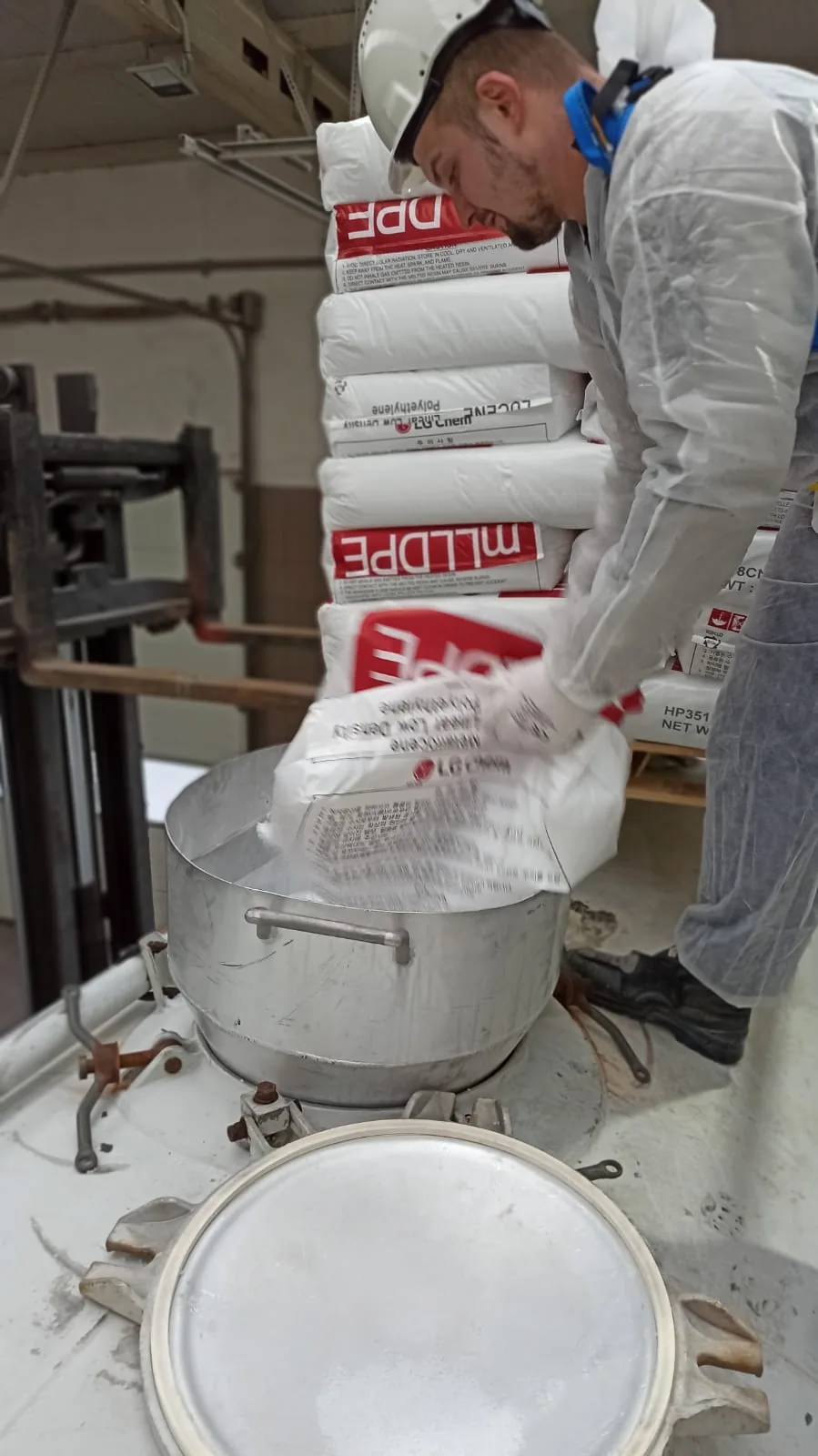
The most common operation at the terminal is, however, not the choice of “bag or big-bag”, but the transition from big-bag to bags — that is, packing. Granulate imported in bulk or in big-bags must be broken down into commercial portions that will go to smaller customers. This is precisely what we do in Chorula: we receive the material in big-bags or from a silo and pack it into 25 kg bags, ready for distribution.
Packing at the Chorula terminal
Packing granulate from a big-bag into 25 kg bags is an operation in which cleanliness and quality control are key. The process at our terminal proceeds as follows:
- Receipt and identification of the big-bag — checking the batch number, the material certificate and the condition of the packaging. Each batch retains full traceability.
- Gravity discharge of the big-bag — the material flows from the big-bag into the feed hopper of the packing station, without pneumatic conveying. Thanks to transloading without pneumatics , the grain is not abraded or electrostatically charged, and the batch retains its original quality.
- Cleaning screen — the granulate stream passes through a screen that captures mechanical contaminants, agglomerates and foreign bodies before it reaches the bag.
- Weight dosing and packing — a measured 25 kg portion goes into the bag (valve, FFS or other, depending on the arrangements), which is closed by a weld or valve.
- Palletisation — the bags are arranged on a pallet in a stable stack, usually 40 (8 layers of 5).
- Securing the pallet — a shrink-film hood or stretch-film wrapping, protecting the stack from moisture, dust and shifting in transport.
- Quality documentation — a packing record with full batch traceability.
Retail packing is only one end of our work — the same material just as often goes out in bulk by tanker. Into 25 kg bags we most often pack polyolefins and compounds going to smaller processing plants that use a few hundred kilograms a day and do not need a whole tonne at once.
We carry out packing in Chorula (4 km from the A4 junction), drawing on a buffer of 2000 big-bags in the warehouse, from which the material comes down to the packing stations. You will find the wider context of services in the PHS Magnum — bulk material transport portal, and the bulk repacking offer is described on the big-bag to silo trailer transloading page.
Palletisation and securing
The bag itself is only half the task — equally important is how it is arranged on the pallet and how it is secured. 25 kg bags are most often palletised by 40 (1000 kg) on a euro pallet, in a layout of 8 layers of 5 bags, with layer interlocking ensuring the stability of the stack. Good arrangement is one in which the bags do not form “ears” protruding beyond the pallet outline and in which successive layers bind together, rather than stacking one on another in vertical columns prone to shifting.
Securing the pallet serves two functions: it stabilises the stack and protects the material from moisture and dust in transport and storage. Two main solutions are used:
- Shrink-film hood — film drawn over the whole stack and shrunk with heat, giving a tight, tensioned cover resistant to splashing and dust. The best protection against moisture from outside.
- Stretch film (wrapper) — stretchable film wound around the pallet under tension, firmly binding the bags to each other and to the pallet. Cheaper and faster, it stabilises the stack excellently but protects the top from rain less well (hence it is often combined with a top hood).
In warehouse practice a well-secured pallet of bags stores just as safely as a big-bag, provided dry, covered storage. We write more about the rules of storing granulate on the storing bulk materials page.
Related topics
The 25 kg bag is best understood as the last link in a chain that begins with bulk delivery. The closest topic is the big-bag (FIBC) , from which we most often pack the material, and the film liner , which in a woven bag plays the same role of a moisture barrier. The raw materials of the bag walls are described in the entries on polyethylene and polypropylene . The full retail packing service is presented on the packing page.
Sources
- Regulation (EC) No 1935/2004 — materials and articles intended for food contact (food-grade bags and films).
- ISO 21898 — Packaging — Flexible intermediate bulk containers (FIBCs) for non-dangerous goods (context for bulk packaging).
- Guidelines from film and bag-fabric manufacturers for valve, FFS and woven PP bags.
- Operational practice of the SMIALA terminal, Chorula — Aleksy Pasternak .
