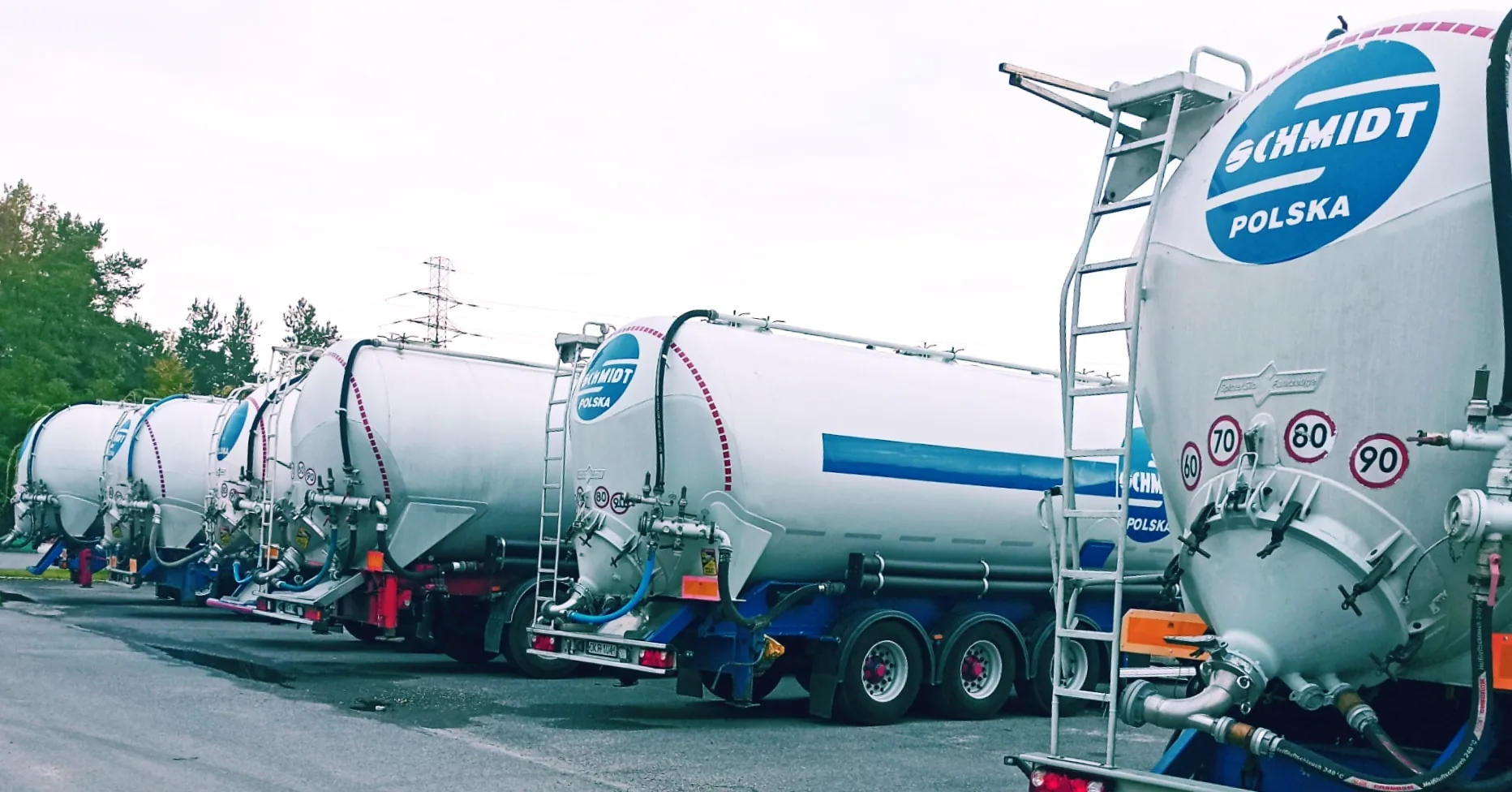
Definition
A silo trailer is a semi-trailer fitted with a pressure tank — most often aluminium — intended for transporting bulk materials loose, discharged pneumatically or by tipping the tank, with a capacity typically from 30 to 90 m³.
In practice it is the silo trailer that closes the delivery chain: after transloading from big-bags at the terminal, the material goes into the silo trailer and travels directly to the silo at the customer’s plant, without any additional repacking along the way. We have operated a fleet of such trailers for years and we know that their apparent uniformity — they all look like a white cylinder on axles — conceals two entirely different philosophies of construction and discharge. Understanding this difference is key both when buying a trailer and when commissioning the transport of a specific material.
Construction of the tank
The heart of a silo trailer is the aluminium pressure tank. The shell is made of an aluminium-magnesium alloy of the 5xxx series — above all EN AW-5083 (AlMg4.5Mn). It is a light material resistant to corrosion, but prone to denting after an impact, which is why accident repairs require TIG welding with ER5183 or ER5356 wire. The frame and chassis are of S355 structural steel or of 6xxx-series aluminium profiles. Trailers for food and chemical products are also found in versions of 304L/316L stainless steel.
The tank is usually divided into 1–5 compartments, which allows different materials or different batches to be carried at once and improves driving stability with a partial load. On the bottom of each compartment are aeration pads — microporous mats through which compressed air is blown. It is these that determine the quality of discharge, and their wear is the most common cause of operational problems.
Besides the shell itself, the construction comprises a number of elements that in daily operation require attention: top manholes (typically 2–4) with seals of EPDM rubber or silicone, through which the tank is filled; shut-off and bottom valves controlling the outflow of material; a pressure manifold collecting the air from the pads; a pressure gauge and safety valve set at the factory to the working pressure; and a discharge pipe with flexible sections. Each of these subassemblies has its own inspection cycle — neglecting one can immobilise the whole trailer during discharge at the customer’s, far from the base.
Two philosophies of discharge
This is the most important distinction in the world of silo trailers — and at the same time the first thing we ask about when matching a trailer to a load.
Pneumatic discharge (non-tipping trailers). Compressed air (in the range of 2 bar) passes through the aeration pads on the tank bottom. The material fluidises — behaves like a liquid — and flows to the manifold, from where it is pushed by the discharge pipe into the customer’s silo. This is the solution for light, well-flowing materials: PE/PP granulates, flour, starch, sugar. The full discharge of a loaded trailer typically takes from a few dozen minutes to about an hour and a half — depending on the material, the height of the customer’s silo and the compressor’s capacity. The air is supplied by a compressor driven from the tractor engine or a separate compressor; its efficiency and cleanliness (drier, filter) translate directly into the pace and safety of discharge. Damp air is a straight road to caking a hygroscopic material in the pipe.
Tipping discharge (tipping trailers). The tank is raised hydraulically at an angle, and the tilting assists gravity emptying; the discharge is also pneumatic, but the tilting helps with materials of poor flow. They are used for cement, lime, ashes and other heavy, dusty materials, which with aeration alone tend to sit in the corners.
Types and manufacturers of silo trailers
The European market is dominated by a few manufacturers, and each designates its series according to the same logic: non-tipping trailers separately, tipping ones separately.
- Spitzer (Elztal-Dallau, Germany) — the SF series are non-tipping trailers with a capacity of about 23–63 m³ with pneumatic discharge; the SK CAL series are tipping trailers of about 38–89 m³. Examples of real designations: SF 2745, SK 2760 CAL (the number in the designation corresponds approximately to the capacity in m³).
- Feldbinder (Winsen/Luhe, Germany) — EUT is a non-tipping aluminium silo with pneumatic discharge (about 31–60 m³); KIP (Kippsilo) is a tilting pressure silo (about 38–66 m³), aluminium, for cement and powders.
- Kässbohrer — the aluminium K.SSK (tipping, about 40–90 m³) and K.SSL (non-tipping, about 31–54 m³, one of the lightest on the market) series.
A fair amount of myth and erroneous designations has grown up around these brands — in the secondary market one comes across “series names” that never existed in the manufacturers’ catalogues. When selecting parts and servicing, it is always worth starting from the data plate and the tank number, not from a colloquial designation.
How to choose the right type? The rule is practical and comes down to the material. Plastic granulate, flour, sugar, animal feed — a non-tipping trailer with pneumatic discharge (SF, EUT, K.SSL). Cement, lime, fly ash, materials of poor flow with a tendency to cake — a tipping trailer (SK, KIP, K.SSK), where tilting the tank completes the discharge where aeration alone would not suffice. A mistake in the choice is not abstract: a non-tipping trailer with cement means the material sitting and a drawn-out discharge, while a tipping one with delicate granulate is a risk of grain damage and an unnecessary complication of the construction.
The most common operational faults
From the fleet’s perspective, a silo trailer fails in predictable places, and most problems reveal themselves only during discharge at the customer’s. The four most common are:
- Worn aeration pads — they lose permeability through abrasion, alkaline attack (cement, lime) or oiling by air from the compressor. Symptom: uneven or incomplete discharge, “dead zones” with material on the bottom.
- Leaking manhole seals — hard, crumbled rubber does not hold pressure. Symptom: a pressure drop during the test, dust around the manhole.
- Blocked bottom valves — dried residual material blocks the mechanism. Symptom: the valve does not open or does not close fully.
- Corrosion of aluminium couplings — especially after alkaline materials. Symptom: difficulty in disconnecting, leaks at the joints.
That is why a silo trailer, like any pressure device, requires regular inspections — not merely a reaction after a breakdown.
Capacity and payload
The most common question is: “how much does it carry?” — and the answer depends not on the volume but on the density of the material. A 60 m³ silo trailer filled with PE granulate of a bulk density of about 0.55 kg/l will take about 27–33 tonnes, while the same volume of cement (density about 1.3 kg/l) will be limited by the permissible gross weight of the combination, not the tank volume.
That is why in the transport of light granulates what counts is volumetric capacity, and the 55–65 m³ class is the optimum: it allows the permissible payload to be used up with light material without exceeding the dimensions. Our fleet — 26 DAF XF 480 Euro 6 tractor units and 31 silo trailers in the approximately 60 m³ class — is matched precisely to this load profile.
This is precisely where the advantage of aluminium reveals itself: every kilogram of the trailer’s tare is a kilogram less of load that may be taken at the same permissible weight of the combination. A light aluminium tank allows more granulate to be carried per run, and manufacturers compete in lowering the tare — hence the trailers on the market advertised as “the lightest in their class”. With light material, where the limit is volume, this difference plays a smaller role; with heavy materials, where the limit is mass, it decides the profitability of every run.
Couplings and compatibility
The most prosaic, and at the same time the most common, cause of downtime during discharge is a coupling mismatch. In silo trailers the standard is the Storz quick coupling — a symmetrical claw coupling, fast to connect and common in silo installations. Alongside them, flange PERROT couplings are found (especially with cement and construction materials) and lever Camlock couplings. Couplings differ not only in the method of connection but also in the nominal diameter — it is this that determines throughput, and therefore the discharge time.
The customer’s installation may have a different standard or diameter, so compatibility must be confirmed before the trailer sets off — an adapter carried “just in case” is not a whim in this industry but an item of equipment. An experienced carrier establishes the type and diameter of the coupling already at the order stage, not under the customer’s silo, where the lack of a matching reducer means returning with a full trailer and another run.
TDT inspections and technical supervision
The tank of a silo trailer is a pressure device subject to technical supervision exercised by TDT (the Transport Technical Supervision authority). This means an obligation of periodic inspections and — after every welding repair affecting the tank — an ad-hoc inspection before being allowed back into service. Operating a trailer with an out-of-date inspection is not only a technical risk but also a formal exclusion from transport.
In practice it is worth remembering one thing: the inspection must be planned in advance. If the examination reveals the need for a repair — replacing seals, regenerating valves, a welding repair of the shell — the trailer is withdrawn from service until it is carried out and accepted by the inspector. Submitting the tank at the last moment can mean a downtime of several weeks at the peak of the season. We carry out full service and preparation for examinations in the PHS Magnum hall — more on this in the silo trailer service section.
Cleaning and cross-contamination
When changing the load, the tank must be cleaned and the cleanliness documented. In European transport the standard is the EFTCO Cleaning Document (ECD), issued by the wash station and describing the scope and method of cleaning. For high-purity granulates this is a condition of the trailer being accepted by the customer — the smallest residue of the previous material or of moisture can disqualify the whole batch.
Cleaning is carried out dry (blowing through, suction) or wet, and the method is matched to the material: after cement, the deposit must be thoroughly removed, after food granulate — washing with a cleanliness certificate and often drying, because residual moisture is a bigger problem here than crumbs. The critical points are the bottom corners, the aeration pads and the dead spaces at the valves — these are where residue is easiest to leave, residue that with the next load becomes a seed of contamination. This is also the reason why, for the most demanding granulates, gravity loading without pneumatics is used, limiting the contact of the material with components that could contaminate it.
Related topics
The silo trailer is the last link in the bulk-material chain, beginning at the big-bag and the transloading method. You will find the full transport offer in the PHS Magnum portal.
Sources
- Technical documentation of silo trailer manufacturers (Spitzer, Feldbinder, Kässbohrer).
- Regulations on technical supervision — examinations of pressure devices (TDT).
- EFTCO — European Cleaning Document (ECD).
- Operational practice of the PHS Magnum / SMIALA fleet — Aleksy Pasternak .
