Definition
Quartz sand (silica sand, silica) is a loose mineral material composed for the most part of quartz grains, that is the crystalline form of silicon dioxide (SiO2). It is a heavy, hard and abrasive material, and its dust in the form of crystalline silica is harmful to health. It is used in foundries, the glass industry, water filtration and construction.
Among bulk materials, quartz sand sits at the opposite pole from light polyethylene granulates — closer to such heavy cargoes as cement . It is a good example of a cargo whose entire logistics is decided not by volume but by mass and grain character. A material seemingly the simplest possible — “sand is sand” — yet demanding in practice, because it combines three troublesome features: it is heavy, it is abrasive, and it generates dust that must not be inhaled.
Quartz is one of the most common minerals in the Earth’s crust. Quartz sand is formed by the natural weathering of silica rocks, and for industrial applications it is mined, washed, classified into fractions and often dried as well. What distinguishes technical sand from ordinary construction sand is the control of purity and grain size — in many applications this determines the suitability of the raw material.
Composition and properties
The basic component of quartz sand is silicon dioxide SiO2, whose content in technical raw materials usually exceeds 95%, and in the highest grades of glass and foundry sands reaches 99% and more. The remainder consists of mineral impurities — above all iron oxides, aluminosilicates and micas — whose quantity translates directly into the quality grade of the material.
The most important physical properties relevant to logistics:
| Parameter | Typical value |
|---|---|
| Main composition | SiO2 (quartz) usually >95% |
| Real (quartz grain) density | ~2650 kg/m³ |
| Bulk density (dry, loose) | ~1400–1600 kg/m³ |
| Bulk density (compacted) | up to ~1700 kg/m³ |
| Mohs hardness | 7 (very hard, abrasive) |
| Technical grain size | usually 0.1–2.0 mm (fractionated) |
| Moisture (dried sand) | below ~0.2% |
| Character | heavy, free-flowing (dry), abrasive, non-flammable |
| ADR classification | none — not a dangerous good |
Three of these parameters determine how sand is transported and transloaded: bulk density, hardness (abrasiveness) and moisture. I will discuss them in turn, because it is these — and not the trade name — that dictate the technology.
Types of quartz sand
Although chemically we are dealing with the same mineral, the market divides quartz sand into several groups according to purpose and quality requirements:
- Foundry (casting) sand — a raw material for making moulds and cores in metal foundries. What counts here is the refractoriness of the grain, its shape and the homogeneity of the grain size, as well as permeability to gases. Foundry sand undergoes precise grain classification, because the quality of the castings depends on it.
- Glass sand — a raw material for glassworks with the highest demands on chemical purity. The iron oxide content must be minimal, because even trace amounts give the glass a greenish tint. It is one of the technically purest types of sand.
- Filtration sand — fractionated, washed sand for filter beds in water treatment plants and swimming pools. Here uniform grain size and the absence of organic impurities are crucial.
- Dried and construction sand — broadly used in dry mortars and mixes, grouts, adhesives, bedding, and after drying as an additive to industrial mortars. Dried sand, of strictly defined moisture and fraction, is a typical bulk load for silo trailers.
From the terminal’s perspective, these differences translate mainly into transloading cleanliness requirements. Glass or filtration material is handled in a regime of full batch separation, so as not to introduce a foreign grain or contaminant — a similar approach to that used for cross-contamination of granulates , only for a mineral material.
Bulk density and its significance
This is the key logistical feature of sand. The bulk density of dry quartz sand — about 1400–1600 kg/m³ — is roughly twice as high as that of a typical polypropylene granulate (approx. 500–650 kg/m³). The consequence is fundamental: with sand the limit is mass, not volume.
Let us explain this with figures. A silo trailer with a capacity of about 60 m³ filled with PP granulate of a bulk density of about 550 kg/m³ will carry a little over 30 tonnes and be filled to the brim — limited by the permissible gross weight of the combination. The same trailer filled with sand of a density of 1500 kg/m³ we will fill to just over a third of its volume before reaching the permissible gross weight of the combination. In other words: the tank remains largely empty, because the load “runs out” by mass, not by volume.
The practical conclusion from the terminal is that for heavy materials such as sand or cement there is no point in maximising tank capacity — the trailer will never be filled by volume. That is why heavy mineral materials are often carried in trailers of smaller volume but adapted to heavy loads and gravity discharge, and the loading itself is planned with even axle-load distribution in mind. The same “mass before volume” principle governs the transport of cement and calcium carbonate .
Abrasiveness — why sand destroys installations
Quartz has a hardness of 7 on the ten-point Mohs scale — it is a material harder than most steel. In practice this means that sand in motion abrades everything it comes into contact with. Every sharp-edged grain, pushed under pressure across a metal or rubber surface, acts like a miniature abrasive knife.
For bulk-material logistics, the abrasiveness of sand has two practical consequences:
- Wear of the pneumatic installation. In pneumatic discharge sand races through the pipeline at a speed of tens of metres per second. At every elbow, bend and constriction the stream of grains abrades the pipe wall — elbows wear out fastest, sometimes worn through entirely within a single season. Blower vanes, valves and pads also wear. This is a real, recurring operating cost.
- Choice of transloading method. For this reason abrasive materials, whenever possible, are transloaded and discharged by gravity rather than pneumatically. A tipping trailer or tipping tank allows the sand to be poured out under its own weight, without driving it under pressure through narrow lines. The philosophy here is consistent with what we describe in the article on transloading without pneumatics : less movement under pressure means less wear on equipment and less dusting.
In my experience it is precisely abrasiveness, alongside mass, that most strongly distinguishes the handling of sand from that of light, soft polymer granulates. Granulate has to be protected from the installation; with sand it is the installation that has to be protected from the material.
Moisture — dried versus damp
The moisture state of sand determines whether it is suitable at all for pressure discharge from a silo trailer. Dried sand — with a moisture content below a few tenths of a percent — is perfectly free-flowing, pours and doses freely, so it can be carried in silo trailers and discharged pneumatically or by gravity. It is a typical bulk load for the dry building-mix industry.
Damp sand behaves entirely differently: the grains stick to each other and to the walls, the material cakes, bridges in hoppers and refuses to flow. Pneumatic discharge of such sand can be impossible, and dosing inaccurate. That is why damp material or material of a broad, coarse grain size is most often carried by tippers and tipping trailers, with gravity discharge through the rear opening. Moisture is one of the first parameters we ask about when establishing the transport method for a given batch — because it is moisture, not tonnage, that decides whether a pressure tanker or a tipper is in play.
Bulk and big-bag transport
Quartz sand is carried in two basic forms, depending on the scale and the customer’s requirements:
- In bulk — by silo trailers and tipping trailers. For large, regular deliveries of dry sand to plants (glassworks, dry-mix producers, foundries), bulk transport is the most efficient. Dry, free-flowing material travels by silo trailer , while damp or coarse-grained material travels by tipping trailer. Loading is done by gravity from a silo or bin; discharge at the customer depends on moisture and the trailer’s equipment.
- In big-bags. For smaller batches, irregular deliveries and materials with elevated purity requirements, big-bags (FIBC) are used, usually with a payload of about one tonne. This is a convenient unit when the customer has no silo infrastructure or when the batch is small enough that a full bulk vehicle would be unjustified. A big-bag of sand is, however, heavy and when full strains the seams more than the same bag of light granulate — worth keeping in mind when selecting the bag class and when lifting.
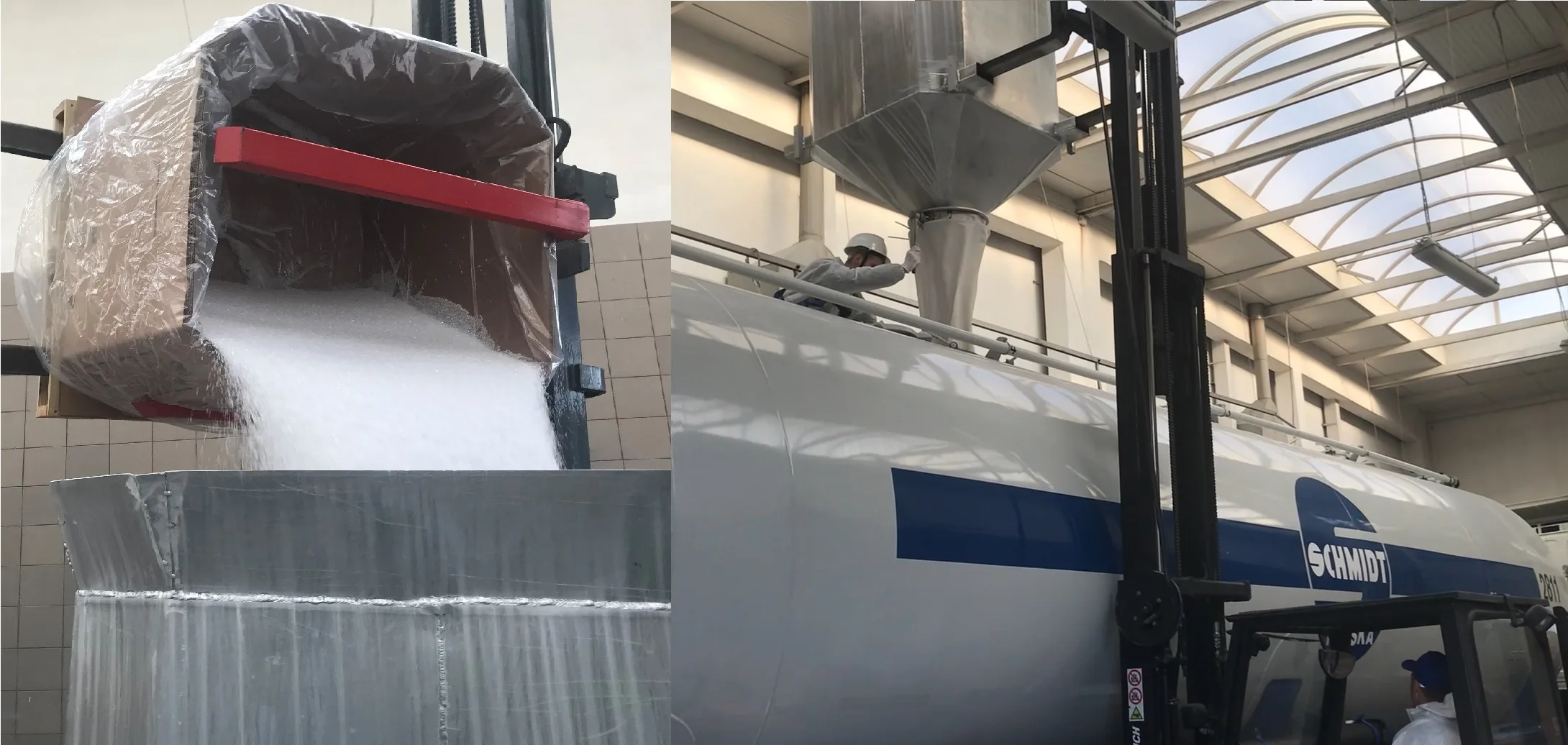
In our terminal’s practice both forms intertwine. Where material arrives in big-bags and the customer needs bulk delivery, we carry out big-bag to silo trailer transloading — with an abrasive material, with particular care for a controlled, gravity transfer and minimisation of dusting. We buffer batches in the bulk material store , and we run the packing service where the customer needs repacking into a different unit. From the terminal in Chorula, 4 km from the A4 motorway junction, we carry out up to 200 tonnes of transloading per day, with a fleet of 26 DAF XF 480 Euro 6 tractor units and 31 silo trailers with a capacity of about 60 m³. We describe the wider context of bulk-material logistics in the PHS Magnum — bulk material transport portal.
Occupational safety — crystalline silica dust
This is the most important section of this article, because it concerns people’s health, not equipment. Sand itself, lying still, is harmless. The problem begins when it starts to generate dust — because the respirable fraction of crystalline silica (particles small enough to reach the pulmonary alveoli) is a serious occupational hazard.
Long-term inhalation of this dust leads to silicosis — an incurable, progressive fibrosis of the lung tissue that permanently impairs breathing. Crystalline silica in respirable form is moreover classified as a human carcinogen (it increases the risk of lung cancer), and work involving exposure to it is treated in labour law as work involving contact with a carcinogen. This is not a theoretical risk — silicosis remains one of the oldest and still present occupational diseases of industry.
This gives rise to specific requirements when handling sand:
- Exposure limits. For the respirable fraction of crystalline silica, rigorous maximum permissible concentrations in workplace air apply. Measurements and exposure assessment are mandatory wherever sand is transferred, ground or screened.
- Dust extraction at source. Transloading and discharge of sand are carried out so as to limit the generation and dispersal of dust — covered transfer points, local extraction, limiting the drop height of the stream and, if necessary, water spraying. A gentle gravity transfer generates less dust than pneumatic transport under pressure.
- Respiratory protection. Where dusting cannot be eliminated by technical means, dust masks of an appropriate filtration class are mandatory, along with hygiene procedures (washing, work clothing, a ban on dry sweeping in favour of vacuuming).
For me, as a terminal practitioner, the rule is simple and non-negotiable: any material containing crystalline silica is handled as if dust were constantly present — with dust extraction, a controlled gravity stream and personal protection. The hazard does not disappear because the material cannot be seen in the air; the respirable fraction is precisely the one that is invisible.
Related topics
Quartz sand is best understood in comparison with other heavy mineral materials and with the technology of their transloading. The closest topic is cement — the second heavy mineral material in which logistics is decided by mass — and the silo trailer , in which we carry bulk materials loose, including in tipping versions. On the technology side it is worth reaching for the article on pneumatic discharge and on transloading without pneumatics , because they explain why gravity is preferred for abrasive materials. We describe the full transloading offer on the service pages . You will find links to related entries in the section below.
Sources
- Regulation (EC) No 1907/2006 (REACH) — context for the classification and safety data sheets of mineral raw materials.
- Directive 2004/37/EC (carcinogens and mutagens at work) — crystalline silica as a process carcinogen.
- Exposure limits for the respirable fraction of crystalline silica — national occupational safety regulations on maximum permissible concentrations.
- Material data from quartz sand manufacturers (bulk density, grain size, SiO2 purity).
- Operational practice of the SMIALA terminal, Chorula — Aleksy Pasternak .
