At a Glance
Bulk polymer import from Korea to Europe travels by sea in ISO containers loaded with big-bags (FIBC). After arrival at Hamburg or Gdańsk, the material moves to a transloading terminal where FIBC bags are transferred into silo trailers for final delivery to converters in Poland, Germany, Austria and beyond. SMIALA terminal in Chorula serves as that intermodal transloading hub — gravity method, no pneumatics, ISO 9001:2015 documentation.
Why does Korean granulate arrive in big-bags?
South Korea is one of the world’s largest producers of commodity and specialty plastics. LG Chem, headquartered in Seoul, exports hundreds of thousands of tonnes of PE and PP granulate to Europe each year. HTNS and other Korean freight platforms manage major portions of these cargo flows.
Ocean freight between Asia and Europe operates exclusively in ISO containers (20-foot and 40-foot). A silo trailer — the preferred delivery vehicle for European plastic converters — simply cannot be placed on a container ship. It is too large, too light (when empty), and structurally unsuited to ocean stresses and stacking loads.
The answer is the FIBC big-bag: a flexible woven polypropylene bag rated for 1,000–1,250 kg of granulate per bag. Big-bags stack perfectly on container pallets:
- 20-foot container: 18–22 big-bags ≈ 18–22 tonnes of granulate
- 40-foot container: 24–28 big-bags ≈ 24–28 tonnes of granulate
On a single mega-container vessel (24,000+ TEU) tens of thousands of such containers travel together — the economies of scale that make transoceanic bulk polymer import viable.
The full route: Korea → Hamburg / Gdańsk → SMIALA → converter
Stage 1 – Production and loading in Korea
The producer (e.g. LG Chem plant in Daesan or Yeosu) fills big-bags on the production line, applies labels with batch number, MFI (Melt Flow Index) and quality certificate reference. Containers are stuffed at the warehouse or directly at the production site. Korean customs export clearance is completed and the vessel departs from Busan or Gwangyang.
Stage 2 – Ocean freight and port of entry
Typical transit times:
| Route | Sea transit |
|---|---|
| Busan → Hamburg (Suez Canal) | 28–35 days |
| Busan → Gdańsk (via Hamburg feeder) | 30–38 days |
| Busan → Hamburg (Cape of Good Hope) | 38–45 days |
On arrival the container must pass EU customs import clearance in Poland or Germany (T1 or SAD procedure). Only after the cargo receives “released to free circulation” status can it leave the port and travel to the transloading terminal.
Hamburg — one of Europe’s largest container ports (3rd in Europe, ~7.8 million TEU in 2024; the largest is Rotterdam). Time from vessel berth to container gate-out: typically 1–3 business days.
Gdańsk DCT (Baltic Hub) — a rapidly growing Baltic hub with increasing direct call services from Asia. Attractive for receivers in Poland, Czechia and Slovakia thanks to a shorter inland road leg to the destination.
Stage 3 – Inland truck transport to SMIALA
From Hamburg to Chorula: ~900 km via A2/A4 motorway — one full driving day.
From Gdańsk to Chorula: ~580 km via A1/A4 — 6–8 hours.
The container on a skeletal trailer arrives at the terminal gate. The driver registers at the office; the operator verifies customs clearance documents and the CMR. The vehicle is weighed on the truck scales (gross weight at arrival).
Stage 4 – FIBC to silo trailer transloading at SMIALA
This is the core intermodal operation. A forklift extracts big-bags from the container one by one and places them either at the loading station (if a silo trailer is already positioned) or in the warehouse buffer zone.
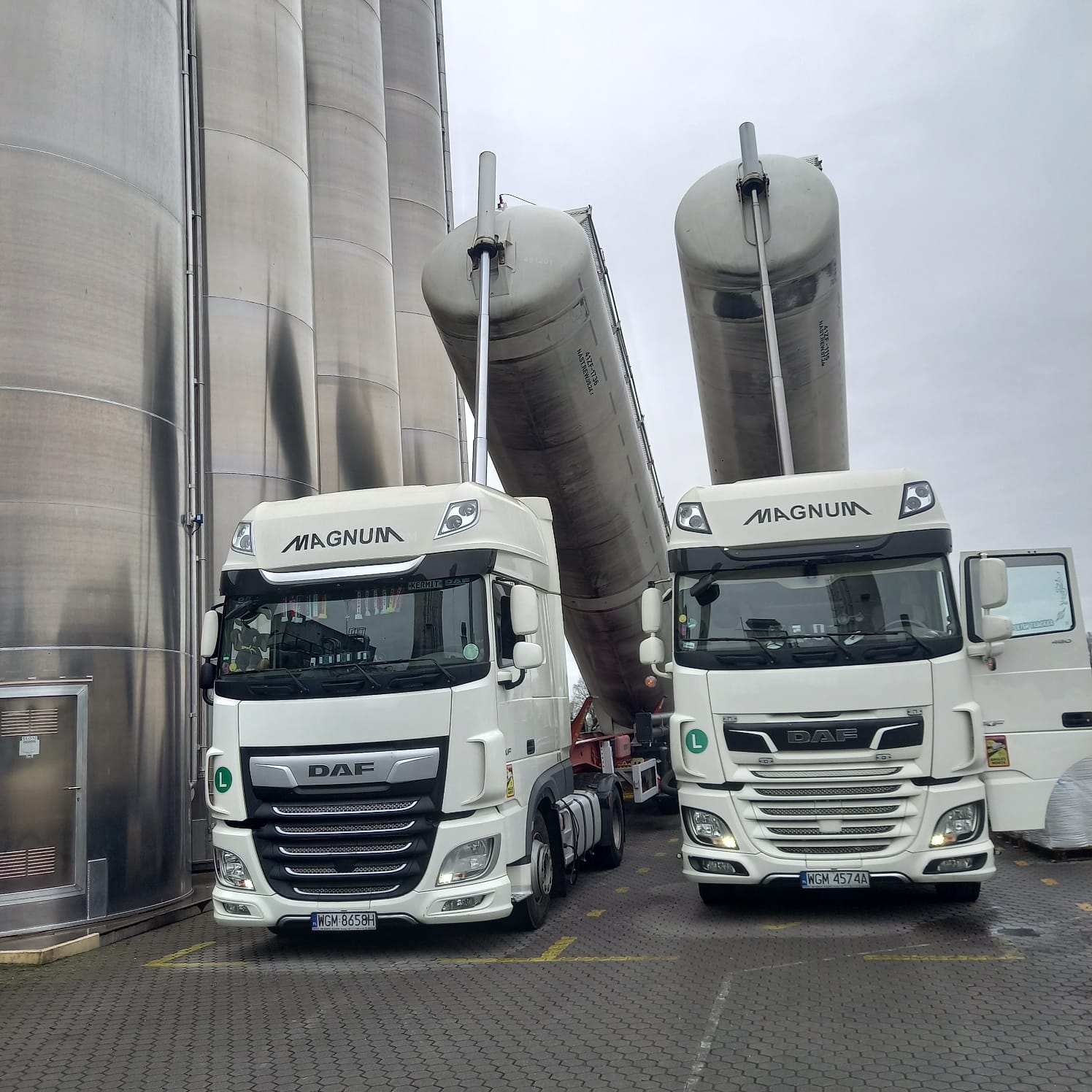
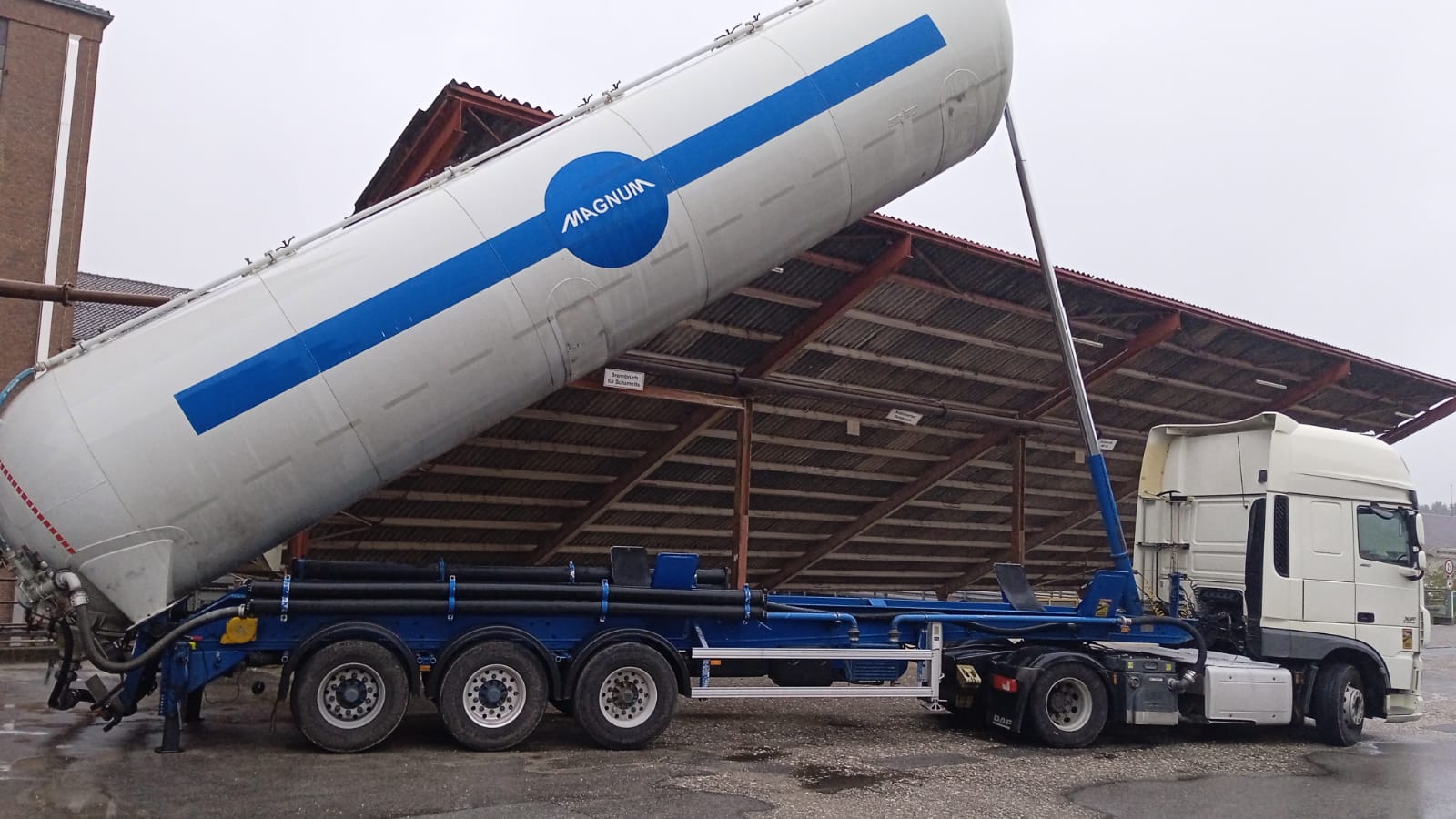
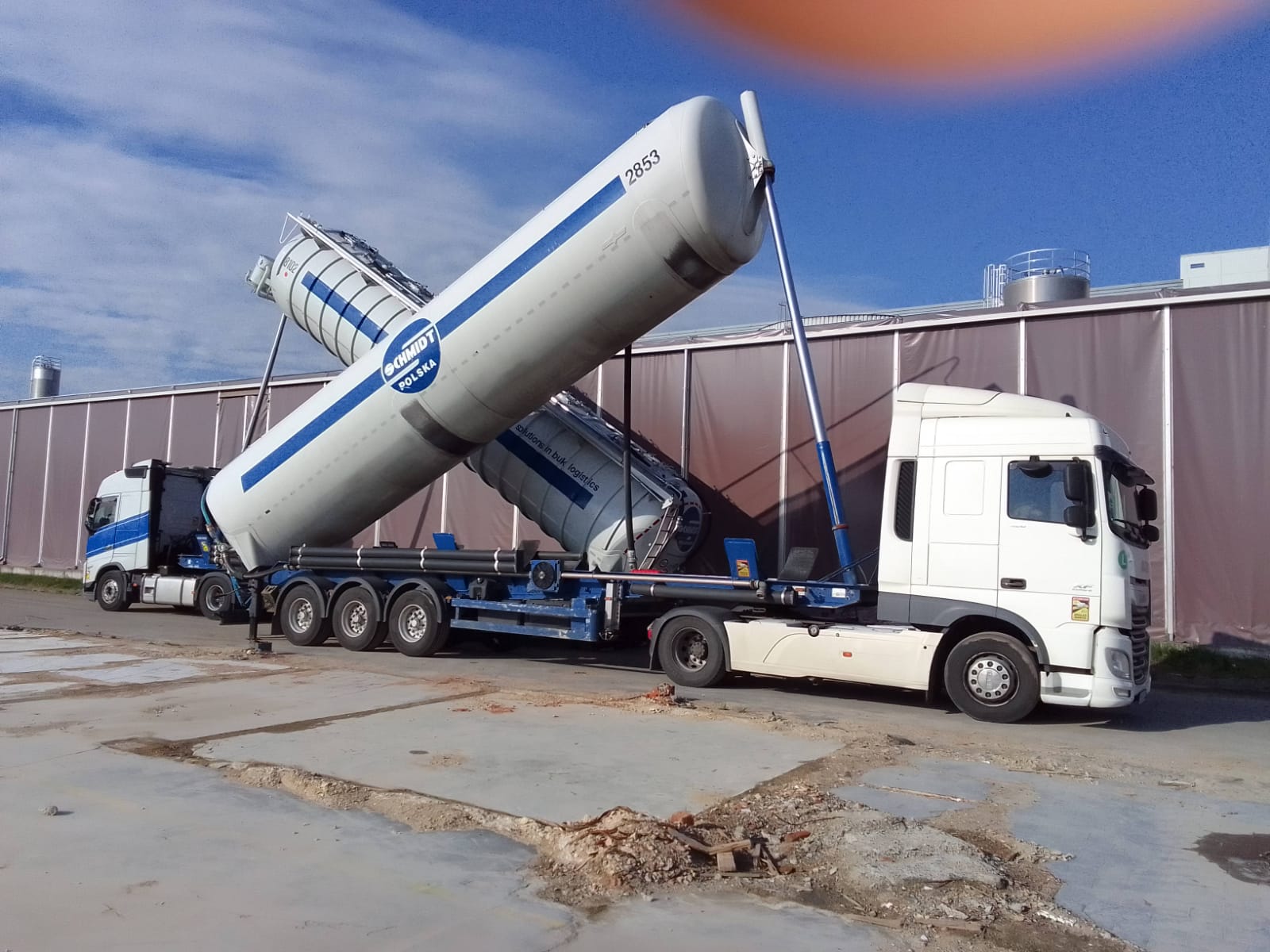
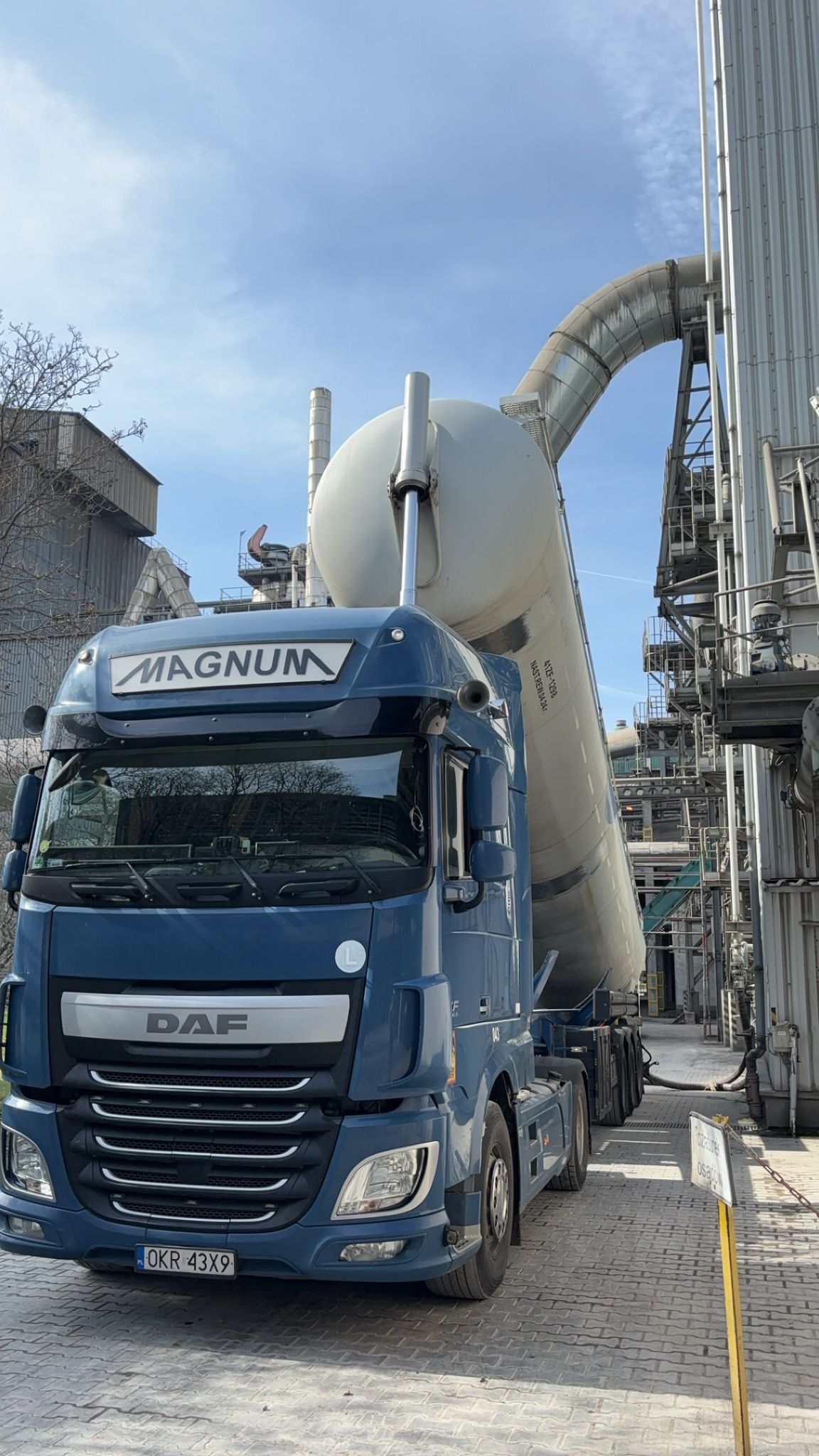
The silo trailer is positioned under the filling station. The operator opens the top filling hatch. A gantry crane or forklift equipped with bale clamps lifts the big-bag to the level of the inlet — approximately 3.5–4.5 m above floor level. The bottom discharge valve of the bag is opened and the granulate flows by gravity into the tank. No pneumatics, no compressed air, no fractionation risk.
Full process details: Big-bag to silo trailer transloading
When container arrivals do not align perfectly with the silo trailer dispatch schedule, SMIALA’s 2,000 big-bag warehouse acts as a buffer. Big-bag warehousing smooths out schedule irregularities and protects against demurrage costs.
Stage 5 – Silo trailer delivery to the converter
The loaded silo trailer leaves the terminal and drives to the converter’s plant. SMIALA’s location in Chorula near Opole — 4 km from motorway A4 — gives direct access to Central Europe’s main road network:
| Destination | Drive time from SMIALA |
|---|---|
| Wrocław (PL) | ~1 h |
| Opole (PL) | ~15 min |
| Katowice (PL) | ~1.5 h |
| Dresden (DE) | ~2.5 h |
| Prague (CZ) | ~3 h |
| Vienna (AT) | ~4.5 h |
180 km from the German border means a single-day round trip to factories in Saxony or Bavaria is entirely feasible.
Why gravity transloading protects Korean granulate quality
LG Chem granulate is sold against a strict quality specification document: MFI, density, ash content, particle size distribution. Any deviation can trigger a complaint or a full batch rejection by the converter.
Pneumatic transloading introduces three quality risks:
Fractionation — the pneumatic pipeline separates particles by mass. Heavier granules settle first; fine dust stays airborne longer. The result is a non-uniform stratified layer in the silo trailer tank — at odds with the homogeneous material in the original big-bag.
Electrostatic charging — friction against the pipe wall builds up static charge on the granulate. Fine particles adhere to the tank walls and may not discharge cleanly at the converter, leaving material residue.
Compressor oil contamination — the pneumatic system includes a compressor. Even with proper filtration, trace amounts of compressor oil can reach the granulate. For food-contact packaging film, potable water pipes or medical applications, this is a disqualifying defect.
Gravity transloading eliminates all three risks. The big-bag is raised above the silo trailer inlet, the bottom valve is opened, the granulate falls under gravity — and that is the entire contact mechanism. No machine touches the product.
Import documentation and SMIALA’s role
A Korean polymer import shipment arrives with:
- Bill of lading (B/L) — title document for the container
- Commercial invoice and packing list — customs data
- Certificate of Analysis (CoA) — technical parameters of the granulate batch
- SAD customs declaration — proof of EU import clearance
SMIALA generates its own transloading documentation:
- Transloading protocol with gross/net weights
- Big-bag list with individual ID numbers
- CMR document (optional, for onward trailer delivery)
All records are archived for a minimum of 5 years — a requirement of ISO 9001:2015 and a standard expectation of corporate supplier audits from LG Chem, HTNS, Borealis and similar organisations.
LG Chem and HTNS – SMIALA’s experience
SMIALA handles PE and PP granulate transloading for suppliers and recipients connected with LG Chem and HTNS. Working with these clients has shaped the terminal’s procedures around:
- Individual big-bag identification and batch traceability
- Zero-tolerance policy on grade mixing
- Proactive communication on cargo status and documentation readiness
ISO 9001:2015 ensures every operation is documented, measured and repeatable across all shifts and all operators.
Book SMIALA as your Korean import transloading hub
If you are importing PE or PP granulate from Korea (or other Asian origins) and need a transloading terminal that receives containers with big-bags and transfers them into silo trailers, contact us:
- Phone: +48 664 135 005 (Mon–Fri 06:00–20:00, Sat 07:00–15:00)
- Email: biuro@magnumchorula.pl
Provide: entry port (Hamburg/Gdańsk), number of containers per month, material grade (PE/PP), destination region. We will prepare an offer within 2 business hours.
SMIALA terminal / PHS Magnum – Chorula near Opole, 4 km from motorway A4, 180 km from the German border
Related: Big-bag to silo trailer transloading | Big-bag warehousing | Services